Skills framework starter kit
An open-source kit to help you design and publish your own human and AI-readable skills framework
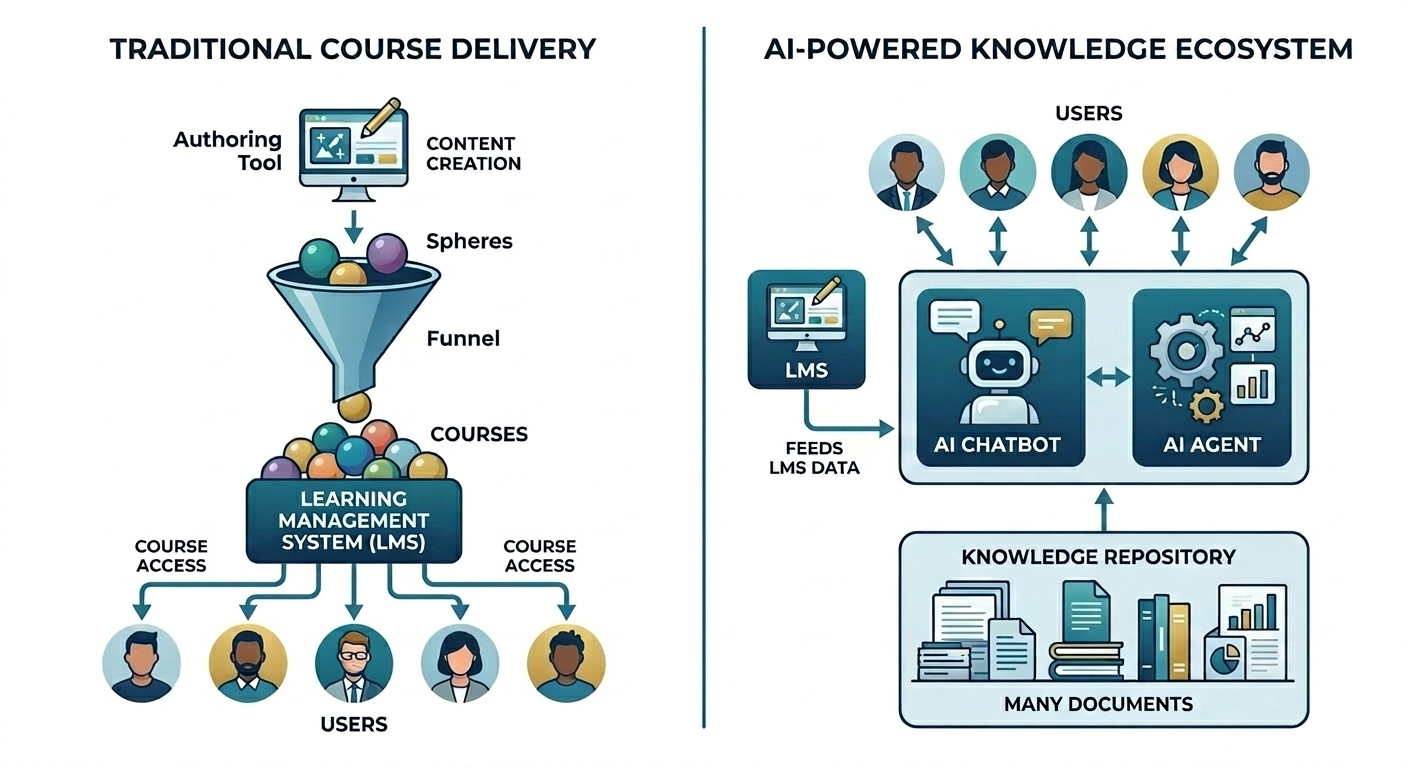
In the traditional model of digital learning, the course has been the default unit of learning. We have used authoring tools to create courses, which are then delivered through a learning management system (LMS) to learners.
For years, experts like Cathy Moore, Jay Cross and Charles Jennings have been advising that courses are just a tiny part of the performance picture and should often be the last resort. Checklists, job aids, and coaching are, in reality, often much more effective. But the course has remained the dominant format for Learning & Development teams. Courses are easier to conceptualise, to package, to sell and to track.
This has led to our learning platforms being full of packaged SCORM content - highly produced products that are often expensive to create and maintain.
There are now some tools that allow us to break these SCORM packages into smaller pieces of content, which can then be reused and repurposed through an AI interface. This is a step in the right direction, but it still treats the course as the starting point for learning. To me, this is a stop-gap, a transitional phase on the way to a more fundamental shift in how we think about learning content and learning architecture.
What happens when the SCORM package itself is no longer the starting point, but is just one of many types of output that people can use to help improve their performance?
Instead of starting with a course, we start with the raw materials: the policies, procedures, knowledge articles, and other documents that contain the information people need to do their jobs. These raw materials are the building blocks, the atoms, on which we can build a learning ecosystem. They can be accessed directly, or more probably via an AI agent/chatbot, using information from other systems (like the LMS) to provide context and relevance, and combined to produce different outputs - a checklist, a job aid, a coaching conversations, or even a full course.
Effective knowledge management processes become the foundation of this new learning architecture. We need to ensure that the raw materials, the atomic content items are current, accurate, and easily accessible.
To do this, we need to establish clear processes for creating, reviewing, version controlling and updating content, as well as for archiving or retiring outdated information.
Most knowledge management strategies currently are based on Word documents, PDFs or pages in a content management system. The new AI-driven learning ecosystem will rely on content that is designed for AI consumption, within the minumum of cruft (unwanted code that costs money to process) around the text.
That will probably be simple text files, often formatted (for human readability) using Markdown (see The Markdown Guide).
AI agents and chatbots will be the glue that holds this new learning architecture together. They will be responsible for accessing the raw materials, understanding the context of the learner’s needs, and combining the relevant content to produce the desired output.
In this new learning architecture, the role of the learning designer will shift from being a course creator to being a content curator and architect. They will need to have a deep understanding of the raw materials, as well as the needs of the learners, in order to train the agents to deliver effective learning experiences.
In this new atomic model of learning, the focus is on creating small, reusable pieces of content that can be easily combined and repurposed to create personalized learning experiences.
This approach allows for greater flexibility and adaptability in the learning process, as learners can access the specific content they need at any given time, rather than being confined to a pre-defined course structure.
The course is dying as the unit of learning - Dr Philippa Hardman
If you'd like to discuss this article, or how I can help you, get in touch.
Posted: 06 May 2026
Tags: Solution design Content management
An open-source kit to help you design and publish your own human and AI-readable skills framework
Was elearning as we know it just a temporary detour?
Rebalancing the spend on learning by building a target operating model for informal learning
Practical habits non-coders can use with AI coding tools to reduce risk and build maintainable, reliable solutions.
With the rise of the AI content creation tools, do we still need elearning authoring software?
A dive into this new technology