
Are your technology decisions creating debt?
I consider the long term impact of quick fixes

We talk about technology solutions but how often do we really understand the problems that this solution is meant to solve?
Do we have a good idea of the difference we’re expecting the technology to make?
Will we be able to measure our return on investment?
To define success, we must start by defining each problem:
A poor problem statement might look like:
“The customer service team is giving out too much poor advice.”
A good version of this might be:
“Over the past 18 months, our customer service surveys have reported a 34% decrease in the quality of responses. This has resulted in a 23% increase in complaints, with 11% leading to ombudsman rulings against us, costing £65,000 in the past year.”
In this case, it would be easy to come to the conclusion that the customer service team needs more or better training, and to put in a learning management system or similar to track that training.
But that would only solve the problem (possibly) if lack of training was the reason for the poor service.
What might be the root cause of the problem?
Why is quality decreasing, and complaints increasing? What’s changed in the last 18 months? Have the people changed? Or the systems they’re using? Or are the products more complex? Or the documentation not clear enough?
That’s when you need to start digging, and mapping the potential causes of the problem.
An Ishikawa or “Fishbone” diagram might be useful:
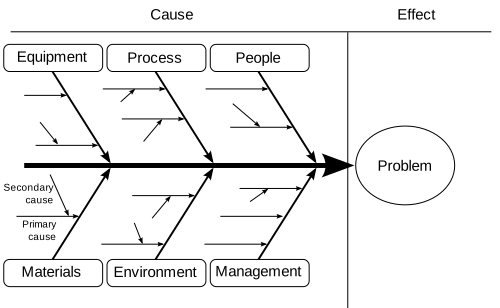
Image by FabianLange at de.wikipedia - Translated from en:File:Ursache_Wirkung_Diagramm_allgemein.svg, CC BY-SA 3.0, https://commons.wikimedia.org/w/index.php?curid=6444290
Once you’ve identified the problem, and possible causes, then it’s tempting to jump straight to solution mode. But, just before you do that, consider how will you know whether the solution is successful.
Go back to the original measures you used for the problem. In our example, we might want to decrease complaints and the annual cost of dealing with them.
That’s the challenge you will need to set your solution providers. Real measurements so both you and they can track the return on investment.
That will help you to create the business case for the solution, and to have confidence in your decision.
If you'd like to discuss this article, or how I can help you, get in touch.
Posted: 02 August 2026
Tags: Decision making Return on investment
I consider the long term impact of quick fixes